
National and state highways
Structural evaluation of existing highway corridors.
Road Infrastructure Testing
Assess pavement structural response through non-destructive FWD testing. GeoSpectra provides pavement deflection measurements and engineering assessment for highway and road infrastructure projects.
Understanding FWD
A Falling Weight Deflectometer, or FWD, loads a road surface with a short, controlled impulse and measures how the pavement responds.
A heavy mass is raised and released onto a buffer system. This creates an impulse load, similar in effect to a moving wheel, which passes into the pavement through a circular loading plate resting on the road. The load lasts only a fraction of a second.
Geophones, which are deflection sensors, are placed at set distances from the plate. As the pavement flexes, they record the surface movement. The readings together form a deflection basin, a profile of how deflection reduces away from the load. Its shape tells engineers how the pavement layers and subgrade share the load.
Because the test is non-destructive, it is widely used for pavement structural evaluation and to plan road rehabilitation without cutting into the road.
Methodology
A typical field programme moves through seven stages. The exact plan is set for each project.
Review the road section, lanes and access, and plan test points and traffic arrangements.
Position the testing vehicle and equipment at each planned location.
Lower the loading plate onto the pavement surface with the sensors in place.
Release the weight so the plate transfers an impulse load to the pavement.
Geophones record the surface deflection at set distances from the load.
Store load, deflection and location data, then review it for completeness.
Where included in the agreed scope, analyse the data and prepare the report.
Applications
FWD testing suits projects where the structural condition of an existing pavement needs to be understood.
Structural evaluation of existing highway corridors.
Deflection response of bituminous pavements under load.
Subject to project requirements and suitable equipment.
Measured data to support rehabilitation planning.
Structural information to complement surface surveys.
Section-by-section data for maintenance prioritisation.
We also test existing roads for structural evaluation as part of wider road testing services.
Schematic only. Not to scale.
Benefits
Surface cracks and rutting show what has happened at the top of a road. Deflection testing adds information about how the whole structure carries load.
FWD data is an input to engineering judgement, not a verdict. Remaining pavement life and overlay thickness cannot be guaranteed from field readings alone. They need proper analysis together with traffic, layer and project data.
Engineering
A clear line separates what is measured in the field from what engineers interpret afterwards.
Equipment configuration, load levels and applicable standards are confirmed per project.
Field Project
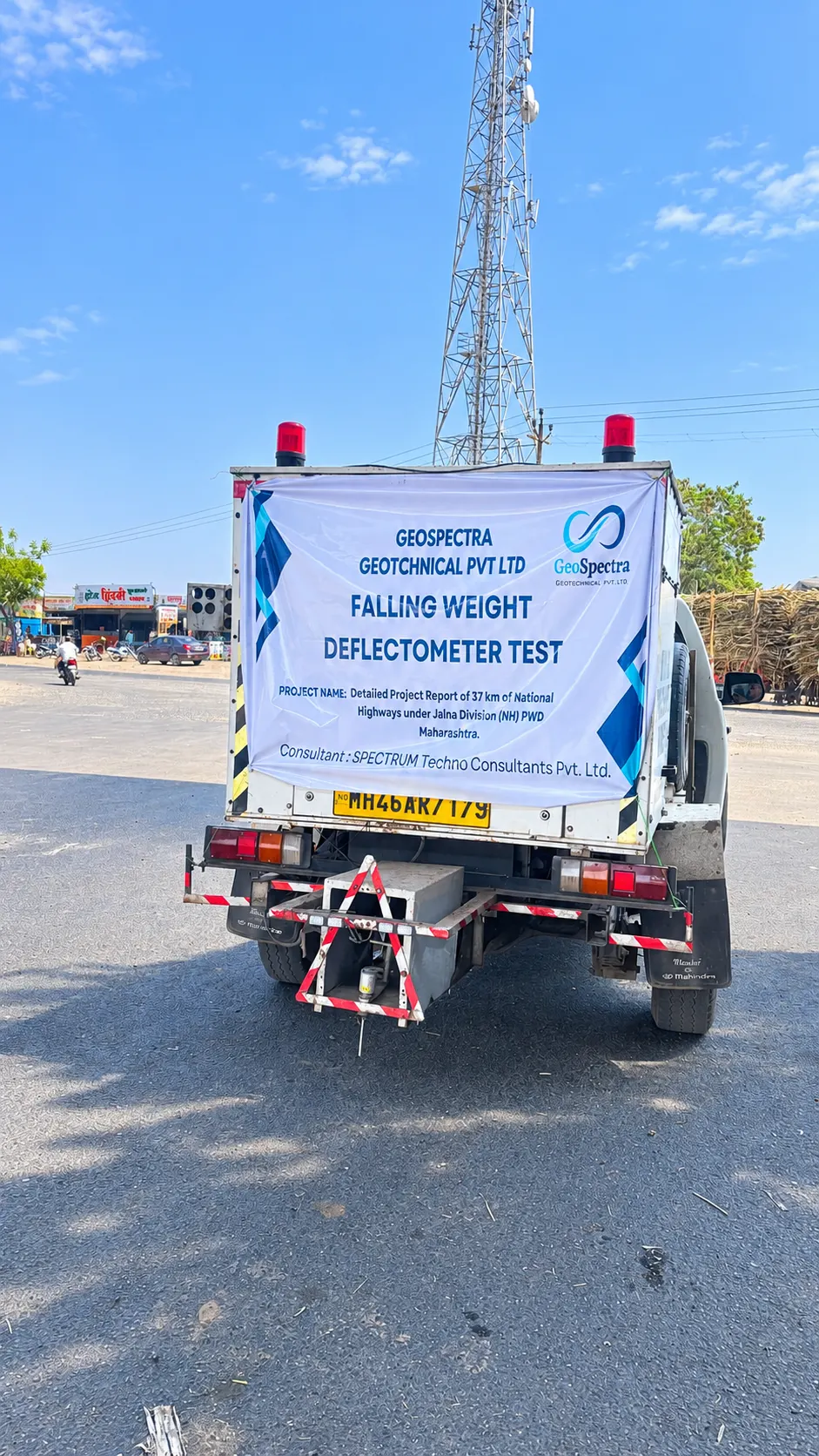
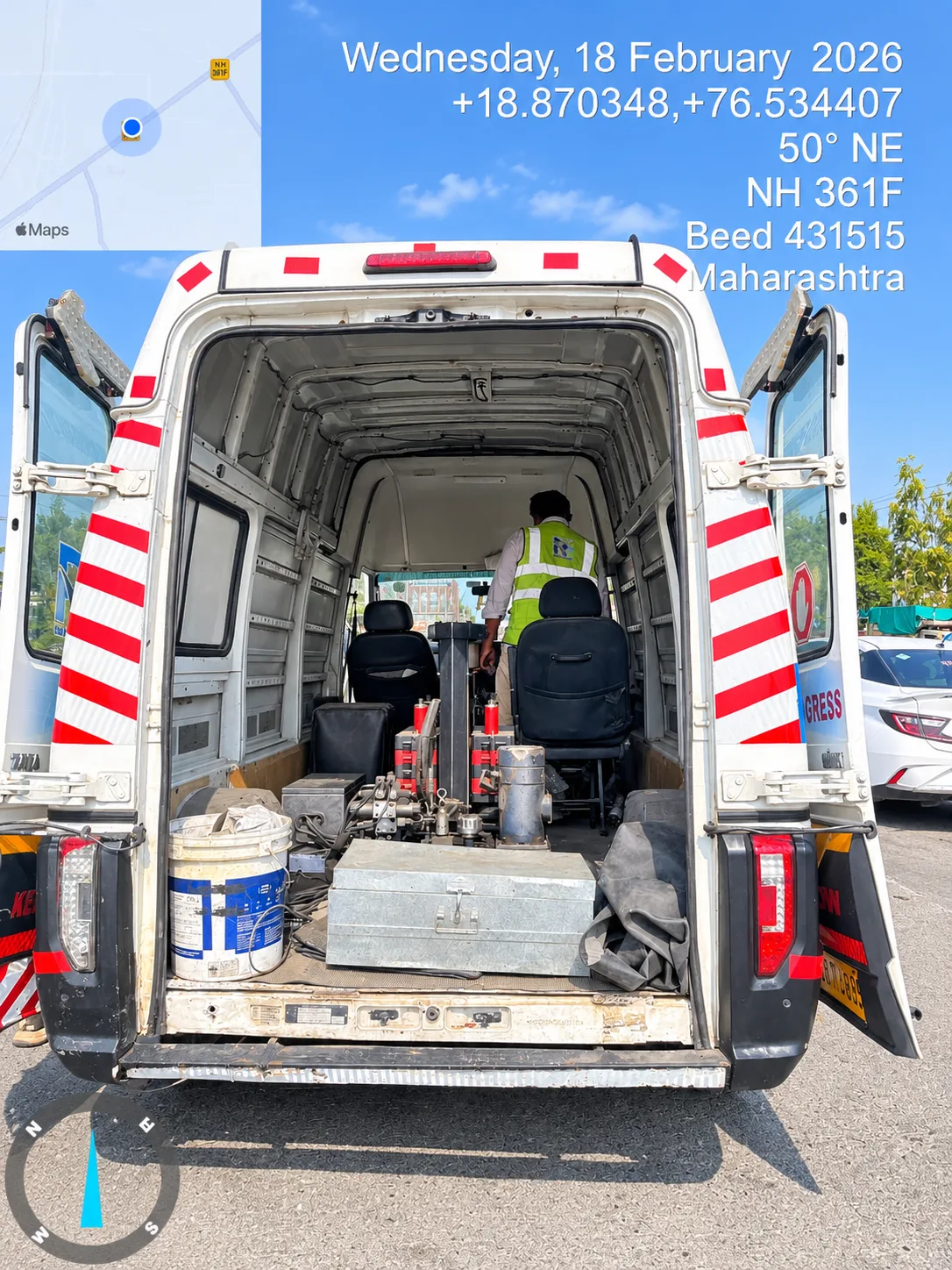
A closer look at GeoSpectra's Falling Weight Deflectometer (FWD) testing vehicle and its field equipment, presented alongside a National Highway project reference from Jalna, Maharashtra.
Reports
What you receive depends on the scope agreed for your project, and we confirm it in the quotation.
Some projects need only the field data. Others need analysis and recommendations as well. Telling us early lets us scope the work correctly and avoid surprises later.
Why GeoSpectra
GeoSpectra Geotechnical Pvt. Ltd. is a geotechnical and infrastructure testing company based in Chhatrapati Sambhajinagar, Maharashtra.
Our work spans geotechnical investigation, field testing and road testing, so pavement questions are viewed alongside ground conditions.
Our road testing range includes FWD, LWD, NSV, skid resistance and other pavement evaluation services.
Each FWD programme is planned around your road, your schedule and your technical requirements.
Reporting is scoped with you, from field records through to analysis where included.
We take on FWD enquiries from across India, with project availability confirmed at enquiry stage.
GeoSpectra is ISO 9001:2015 certified and runs an NABL-accredited soil testing laboratory. View our facilities.
FAQ
Falling Weight Deflectometer testing is a non-destructive method for checking how a road pavement responds to load. A mass is dropped onto a loading plate resting on the surface, which produces a short impulse load, and sensors record how far the pavement surface moves. Engineers use those measurements to evaluate structural condition.
The purpose is to obtain measured structural response data for an existing pavement. Highway owners, contractors and consultants use it to compare sections of a road, find stretches that may be structurally weaker, and support decisions on maintenance, strengthening or rehabilitation.
The equipment is positioned at a planned test point and the loading plate is lowered onto the pavement. A weight is released to apply a controlled impulse load through the plate. Geophones or deflection sensors placed at set distances from the load record the surface movement, and the system stores the load, deflections and test location for review.
Yes. FWD testing loads the pavement surface briefly and does not require cutting, coring or breaking the road. This makes it suitable for assessing existing roads without damaging them. Other investigations, such as coring or trial pits, may still be used alongside it where a project needs to confirm layer thickness or material details.
A deflection basin, also called a deflection bowl, is the pattern of surface deflections recorded at different distances from the load plate. The deepest movement is under the plate and it reduces with distance. The shape of the basin reflects how the pavement layers and subgrade respond, so engineers use it for structural evaluation.
The field test records the applied load, the measured pavement deflections, the test location or chainage and, where recorded, temperature conditions. Engineering analysis can then use this data to compare sections and, where the scope and software allow, to estimate layer stiffness through back-calculation.
It is used on national and state highways, other existing roads, and flexible pavements generally. Typical uses include road rehabilitation projects, pavement condition assessment and pavement management studies. Use on airport pavements depends on project requirements and the equipment suitable for the loads involved.
Both are deflection tests, but they differ in scale. A Lightweight Deflectometer applies a smaller load and is usually used to check stiffness and compaction of subgrade and base layers during construction. An FWD applies a heavier impulse load and is used for structural evaluation of the full pavement. GeoSpectra also offers LWD testing under its road testing services.
Yes, as one part of a wider assessment. Deflection data shows how the pavement structure behaves under load, which visual surveys cannot show. It is usually considered together with surface condition surveys, traffic data and layer information to form a complete picture of highway pavement condition.
It can. Deflection data helps identify sections that behave differently from the rest of the road and gives engineers measured evidence for rehabilitation options. Decisions such as overlay thickness or remaining life need proper engineering analysis and project data, and cannot be read directly from the field measurements alone.
The contents depend on the scope agreed for the project. Reports may include field testing records, applied load and deflection data, test locations and chainage, deflection basin data and technical observations. Engineering analysis and recommendations are included only where they are part of the agreed scope. GeoSpectra confirms deliverables in the quotation.
Send us the project location, road or highway name, approximate length, number of lanes and your testing requirement through the enquiry form on this page, by WhatsApp or by phone. Our team will review the details, discuss the technical scope with you and respond with a quotation.
Enquiry
Connect with GeoSpectra to discuss your FWD testing requirements, project location and technical scope.