
Subgrade Evaluation
Assessment of the deformation response of prepared subgrade.
Road Infrastructure Testing
GeoSpectra provides Lightweight Deflectometer (LWD) testing for evaluating the in-situ deformation response and stiffness of soil and pavement construction layers. LWD field measurements can support construction quality assessment of subgrade, granular base and sub-base materials, based on the project specification and testing requirements.
Understanding LWD
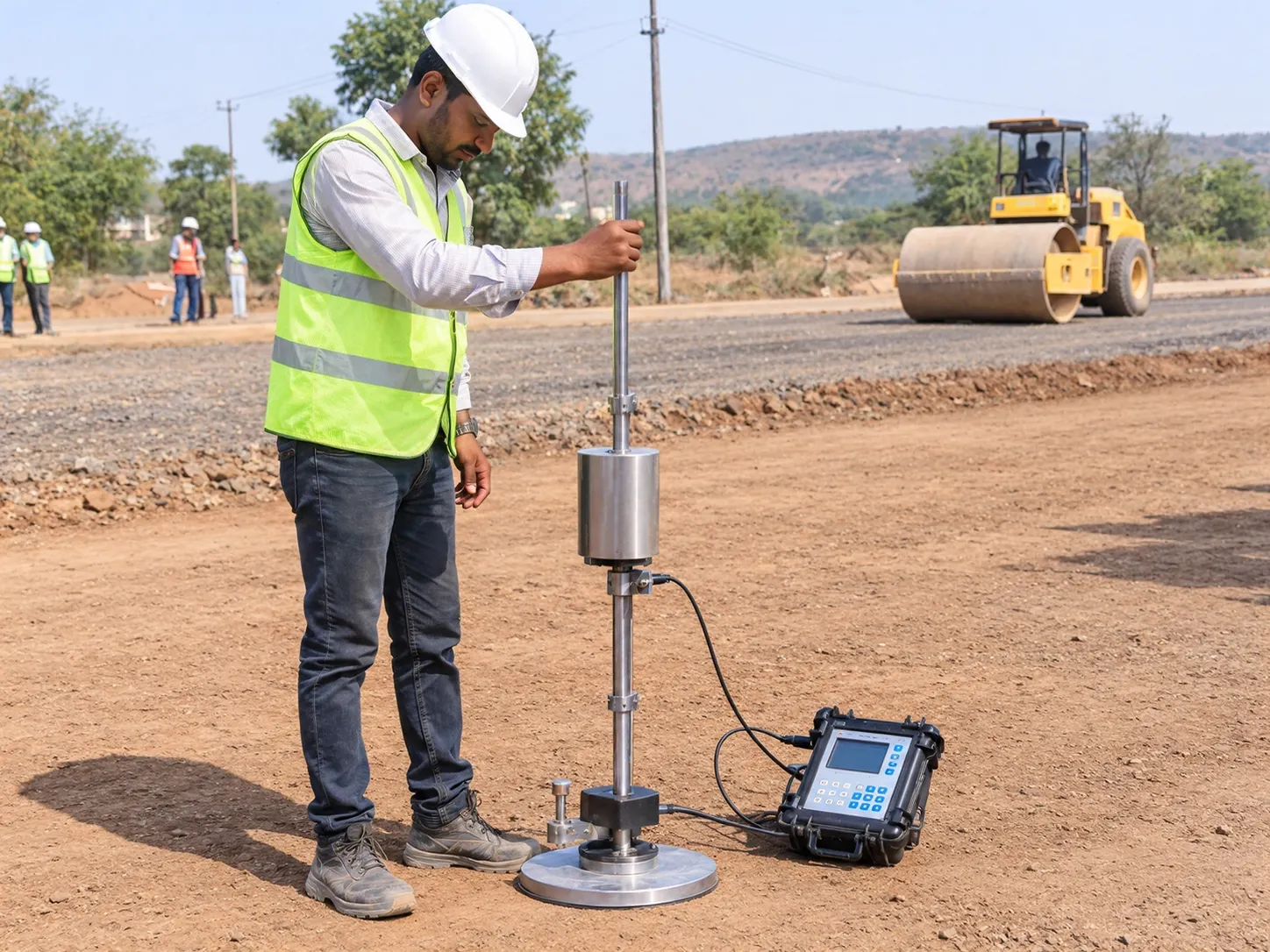
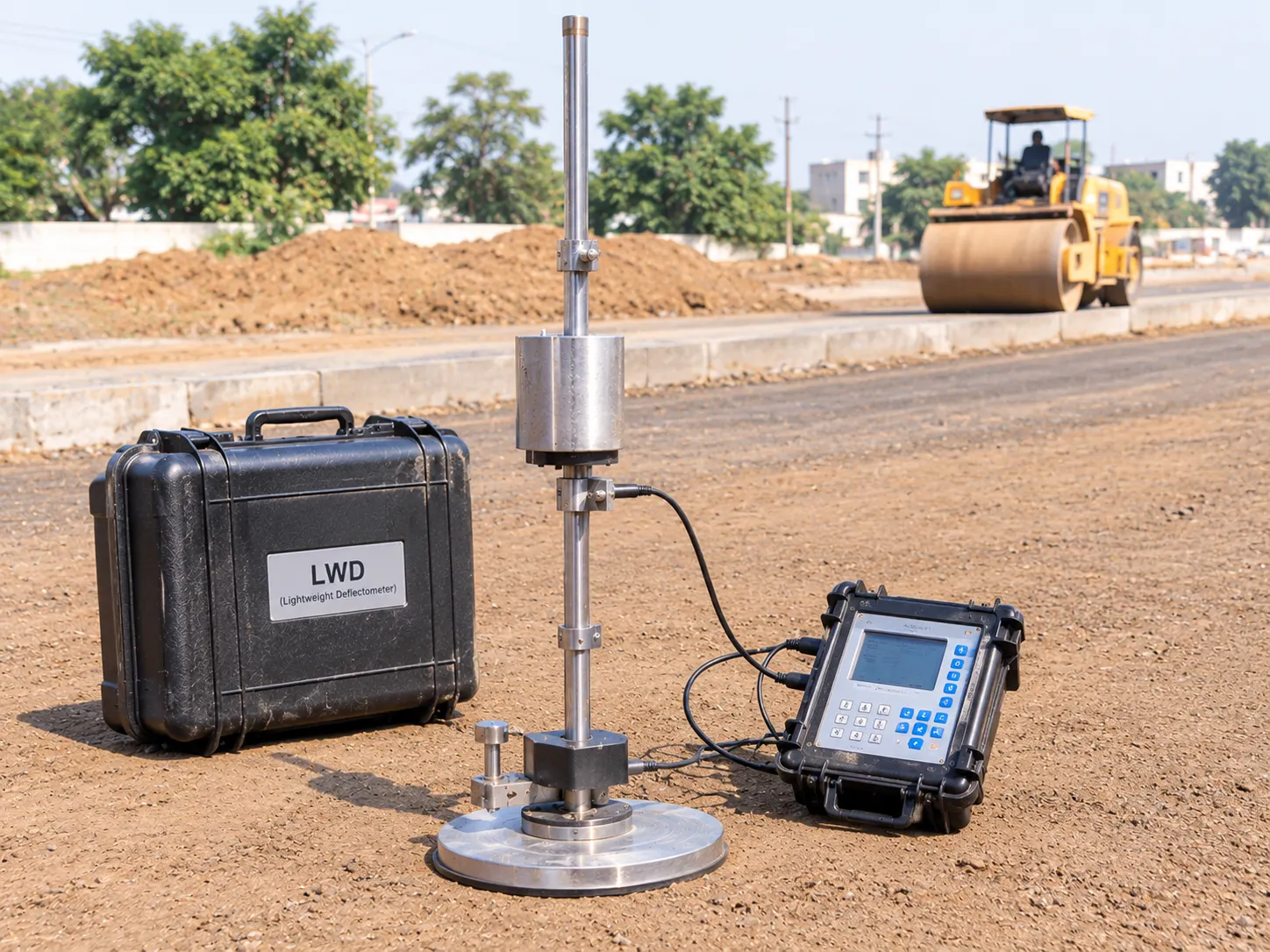
A Lightweight Deflectometer is a portable instrument that applies a controlled dynamic load to soil or a pavement layer and measures how the surface responds.
A mass is released from a set height onto a buffer arrangement, which applies a short load through a circular plate resting on the prepared surface. The instrument's sensor arrangement records the surface deflection. This is the measured field reading.
Many instruments also use the load, plate size and measured deflection to calculate a stiffness-related value, commonly reported as a dynamic deformation modulus. That value is calculated, not measured directly, and it depends on the instrument and calculation method. Sensors, load levels and calculations are not identical across LWD instruments.
The test is used for field assessment of compacted soil and unbound layers, where it gives a quick reading of in-situ response at planned locations. Unlike laboratory compaction testing, which works on a prepared sample, it tests the layer as built, and it complements rather than replaces other road construction quality control tests.
Methodology
A typical field programme moves through seven stages. Plate diameter, drop height, load, number of drops, test spacing and acceptance criteria depend on the equipment configuration and the project specification.
Confirm the layers to be tested, the method to follow, the test spacing and the criteria the results will be reviewed against.
Mark the planned locations and prepare each surface by removing loose material so that the plate can seat firmly.
Check the instrument, plate, mass and sensor, and set it up to the configuration required by the method and specification.
Seat the plate on the surface and check its contact so that the load is applied evenly.
Release the mass to load the plate, following the drop sequence set by the method.
Record the deflection and the other readings given by the instrument, with the test location and field conditions.
Check the readings for completeness, compare locations and prepare the report agreed in the project scope.
Applications
LWD testing suits construction projects where the field response of prepared soil and unbound layers needs to be checked. It is not suitable for every soil type or project condition.
Assessment of the deformation response of prepared subgrade.
Field evaluation of unbound base materials.
Testing of prepared granular sub-base layers.
Supporting field verification during construction.
Assessment of prepared soil layers where the method is suitable.
Project-specific field assessment of soil and pavement construction layers.
We also offer LWD testing in Maharashtra and across India as part of wider road testing services, including field soil testing for construction projects.
Schematic only. Not to scale. Equipment configuration varies between instruments.
Benefits
Laboratory tests describe a prepared sample. LWD testing adds a reading from the layer as it has actually been built, at the location where it is tested.
LWD readings alone do not establish complete soil classification, long-term pavement performance or universal compaction acceptance. Interpretation must follow the applicable project specification and testing method.
Engineering
A clear line separates what is measured in the field from the values calculated and interpreted afterwards.
The test method, equipment configuration and acceptance requirements must be confirmed against the project specification and the equipment manual.
Reports
What you receive depends on the scope agreed for your project, and we confirm it in the quotation.
Some projects need only the field readings. Others also need a comparison of locations and technical observations. Report format and any recommendations are agreed with you in advance, so telling us early lets us scope the work correctly.
Why GeoSpectra
GeoSpectra Geotechnical Pvt. Ltd. is a geotechnical and infrastructure testing company based in Chhatrapati Sambhajinagar, Maharashtra.
Our work spans geotechnical investigation, field testing and road testing, so layer response is viewed alongside ground conditions.
Our road testing range includes LWD, FWD, NSV, skid resistance and other soil and pavement evaluation services.
Each LWD programme is planned around your layers, your test locations, your schedule and your specification.
Field records and reporting are scoped with you, from test-wise readings through to technical observations where included.
We take on LWD enquiries from across India, including Maharashtra locations such as Pune, Mumbai, Nashik and Nagpur, with availability confirmed at enquiry stage.
GeoSpectra is ISO 9001:2015 certified and runs an NABL-accredited soil testing laboratory. The laboratory accreditation applies to laboratory testing and does not extend to LWD field testing. View our facilities.
FAQ
Lightweight Deflectometer testing is a portable in-situ test that checks how soil or an unbound pavement layer responds to a dynamic load. A falling mass applies a controlled load through a circular plate on the prepared surface, and the instrument measures the resulting surface deflection. It is also written as Light Weight Deflectometer and is sometimes described as a dynamic plate load test.
The purpose is to obtain measured field data on the deformation response of a compacted layer, so that construction quality can be checked at planned test locations. Contractors, consultants and project owners use it to compare locations and to support decisions during subgrade, base and sub-base construction, in line with the project specification.
The loading plate is placed on the prepared test surface and the mass is released from the specified height onto the plate through a buffer arrangement. This applies a short dynamic load. The instrument's sensor records the surface response, and its software or the engineer calculates the results. Plate size, drop height, load and the number of drops depend on the instrument and the project specification.
The test measures the surface deflection under the dynamic load, together with the load or drop settings used. Many instruments also calculate a stiffness-related value from these readings, such as a dynamic deformation modulus. The measured deflection is the field reading, while the calculated modulus depends on the instrument and its calculation method.
Dynamic deformation modulus is a stiffness-related parameter calculated from the applied load, the size of the loading plate and the measured deflection. It describes how stiff the tested layer appears under the dynamic load. How it is calculated, and what values are acceptable, depend on the instrument and on the project specification, so it should not be compared across different methods without checking.
It is used during construction to check prepared layers, mainly subgrade, granular sub-base and granular base. It can also be used on earthwork and embankment layers where the method is suitable. Testing is planned at selected locations so that results can be compared across the work and reviewed against the project requirements.
Yes, it is commonly used to assess the deformation response of prepared subgrade. Results depend on moisture, material type and the condition of the surface, and the method is not suitable for every soil or site condition. The test locations, method and acceptance criteria should be agreed against the project specification before testing starts.
It can be used to evaluate the field response of unbound granular base and sub-base layers during construction. Layer thickness, material and the support beneath the layer all influence the readings, so results are interpreted together with that information. Suitability for a particular material or project is confirmed against the specification.
Both are dynamic deflection tests, but they have different loading arrangements and purposes. An LWD is a portable instrument that applies a lighter load and is mainly used to check soil, subgrade and unbound layers during construction. An FWD is a larger, usually vehicle-mounted system that applies a heavier impulse load and is used for structural evaluation of the full pavement, with sensors at several distances from the load. GeoSpectra also provides FWD testing.
No, not by itself. LWD gives a dynamic stiffness or deformation response, while field density tests measure unit weight and are used to find percentage compaction. LWD does not directly measure percentage compaction unless a correlation has been established for the material and method. Where a project uses LWD alongside density tests, the correlation is project-specific and should follow the specification.
The contents depend on the scope agreed for the project. Reports may include test location records, field observations, applied load and equipment configuration where recorded, measured deflection readings, calculated stiffness or modulus values where the instrument supports them, test-wise summaries and a comparison of locations where required. Technical observations and recommendations are included only where they are part of the agreed scope.
Send us the project location, road or project name, approximate area or road length, the layer to be tested and your testing requirement through the enquiry form on this page, by WhatsApp or by phone. Our team will review the details against the specification, discuss the technical scope with you and respond with a quotation, subject to project availability across Maharashtra and the rest of India.
Enquiry
Connect with GeoSpectra to discuss your LWD testing requirements, project location, material layers and technical specifications.