
Published by Geospectra Geotechnical Pvt. Ltd. — Dec 03, 2025
Understanding Pile Load Testing: Methods, Requirements & Engineering Importance
Pile load testing is one of the most crucial steps in evaluating the actual load-carrying capacity and performance of deep foundations. No matter how advanced the design or how experienced the construction team may be, the true behaviour of a pile can only be understood through a field load test. From high-rise buildings and bridges to metro rail corridors, industrial plants and marine structures, pile load testing ensures that the foundation system performs safely, efficiently and as per design expectations.

What is Pile Load Testing?
Pile load testing is a field test conducted to determine the ultimate load capacity, allowable load capacity, settlement characteristics and overall performance of a pile under different load conditions. It confirms whether:
- The designed pile length and diameter are adequate
- Actual soil resistance matches the geotechnical report
- The pile can safely carry the required service loads
- The settlement remains within permissible limits
- The construction quality of the pile is satisfactory
In India, most major government and private projects (NHAI, PWD, Metro Rail, Smart Cities, industrial corridors) mandate pile load testing as part of the quality assurance process.
1. Static Axial Load Test (Compression & Tension)
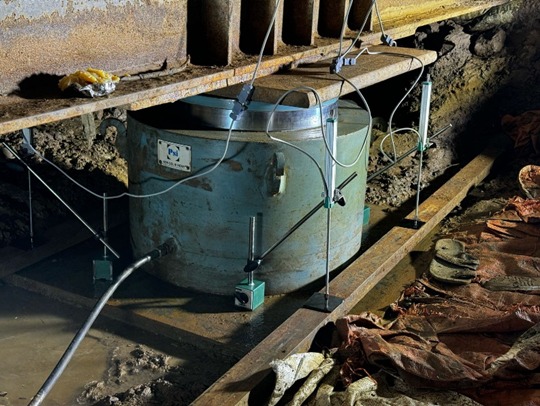
Static pile load testing is considered the most reliable and accurate method for evaluating pile performance. Loads are applied slowly and incrementally while measuring the settlement or uplift. This method replicates actual field conditions and provides dependable long-term predictions.
- Maintained Load Test (MLT): Loads are applied in increments and held for observation. Used to determine safe and ultimate load capacity.
- Constant Rate of Penetration (CRP): The pile is pushed at a constant rate to study soil resistance. Useful for understanding ultimate capacity quickly.
- Tension/Uplift Test: Checks uplift resistance in structures like transmission towers, tanks, chimneys and offshore platforms.
2. Dynamic Pile Load Test (PDA Test)
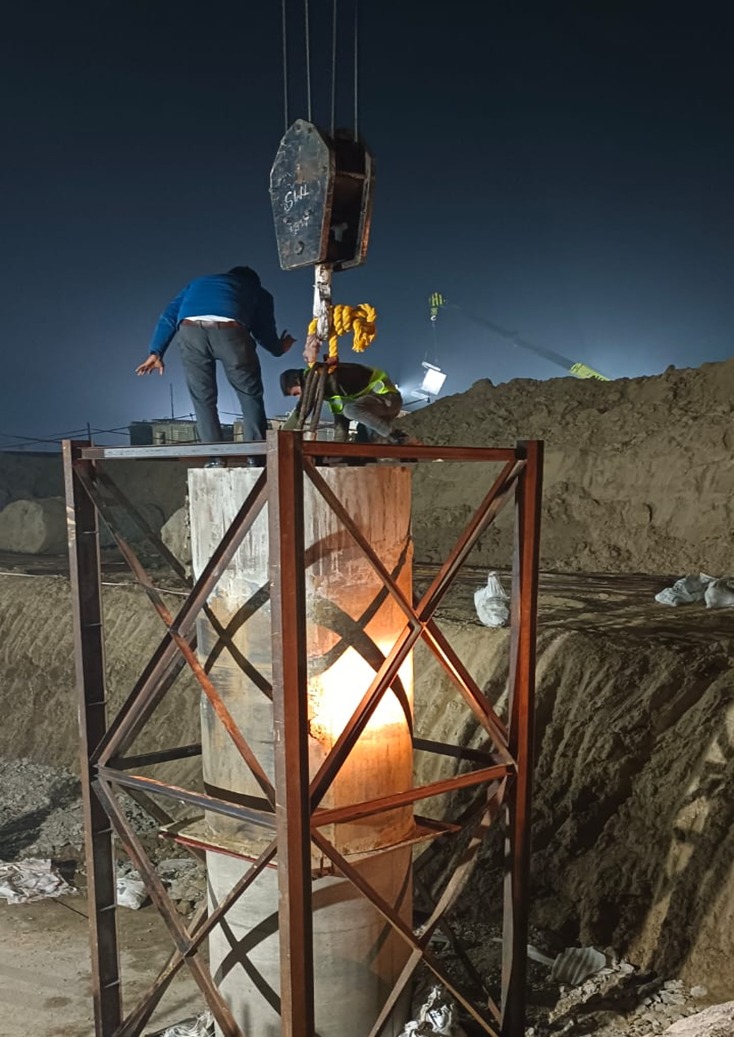
Dynamic pile load testing, commonly known as PDA testing, is performed by applying impact energy using a drop hammer or piling rig. Sensors mounted at the top of the pile record stress waves, allowing engineers to estimate capacity and driving stresses in real time.
- Ideal for projects with a large number of piles
- Quick and economical compared to static testing
- Helps optimize driving criteria during pile installation
- Interpreted using wave equation analysis (CAPWAP)
PDA testing is widely used in highway bridges, industrial plants, port structures and metro rail foundations.
3. Cyclic Load Test
Cyclic load testing evaluates how a pile behaves under repeated loading and unloading cycles — a condition common in wind turbine foundations, marine structures and vibration-prone areas.
- Checks soil-pile interaction during repeated loads
- Assesses long-term deformation patterns
- Determines fatigue resistance and cyclic settlement
Engineering Benefits of Pile Load Testing
Pile load testing provides crucial data that helps engineers refine designs and validate assumptions. The key benefits include:
- Verification of geotechnical and structural design parameters
- Accurate assessment of settlement characteristics
- Identification of weak soil zones affecting pile performance
- Optimization of pile length and diameter, reducing unnecessary costs
- Ensures compliance with IS 2911 and project specifications
- Mandatory for major infrastructure and government-approved projects
Why Pile Load Testing is Essential for Modern Infrastructure
With rapid urban growth, deeper foundations and complex structures, the reliability of piles must be validated under real field conditions. Pile load testing reduces the risk of:
- Foundation settlement or tilting
- Structural cracks and performance issues
- Costly retrofitting and delays
- Premature foundation failure
A well-executed test ensures that foundations are designed optimally — neither under-designed (unsafe) nor over-designed (unnecessarily expensive).
Pile load testing is an essential part of foundation engineering and plays a decisive role in ensuring
structural
safety and long-term performance. Through accurate testing and interpretation, engineers gain confidence in the
capacity and behaviour of piles under actual loading conditions.
At Geospectra, we conduct high precision static, dynamic and cyclic pile load tests using advanced
instrumentation,
experienced technical teams and strict adherence to IS standards. Our approach helps clients achieve reliable,
optimized and cost effective foundation designs.