Published by Geospectra Geotechnical Pvt. Ltd.
Understanding Soil Bearing Capacity: A Complete Guide for Safe Foundation Design

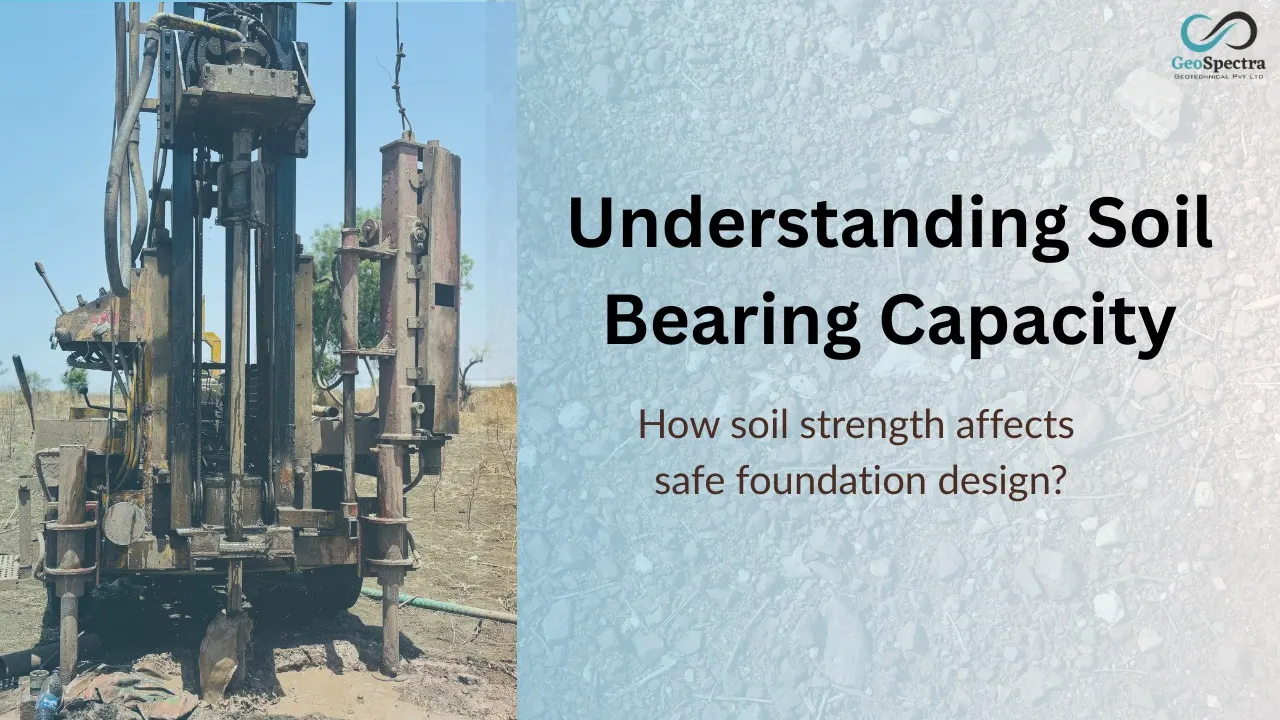
Every building or infrastructure project relies on a stable foundation. But how do engineers ensure that the ground beneath a structure can safely carry its weight? The answer lies in understanding Soil Bearing Capacity (SBC). SBC defines the maximum load that soil can support without experiencing excessive settlement or shear failure. Proper knowledge of SBC helps prevent structural problems like cracks, tilting, or uneven settlement.
What is Soil Bearing Capacity?
Soil bearing capacity is essentially the soil’s ability to support the loads imposed by a structure. When loads exceed this capacity, foundations can fail, leading to costly repairs and safety risks. Several factors influence SBC, including soil type, density, moisture content, and the depth at which the foundation is placed.
There are generally three terms used in foundation engineering to describe soil capacity:
- Ultimate Bearing Capacity – The maximum load soil can carry before failure occurs.
- Safe Bearing Capacity (SBC) – The load considered safe after applying suitable safety factors.
- Allowable Bearing Pressure – The maximum pressure the foundation can exert without causing excessive settlement.
Why Soil Bearing Capacity is Important
Understanding SBC is critical to designing foundations that are both safe and cost-effective. Buildings constructed without proper knowledge of the soil conditions often face settlement issues, cracks in walls, and uneven floors. Correct estimation of SBC ensures:
- Stable and durable structures over time
- Selection of appropriate foundation types based on soil characteristics
- Prevention of structural failures such as tilting or shear collapse
- Optimized construction costs by avoiding overdesign
How Soil Bearing Capacity is Determined
Determining SBC involves a combination of field investigations, laboratory testing, and empirical calculations. Field tests give engineers a direct understanding of soil strength and behavior under load, while laboratory tests help confirm the soil properties and support precise foundation design.
Field Tests
Common field tests used to estimate SBC include:
- Standard Penetration Test (SPT) – Measures soil resistance to penetration and is widely used for preliminary SBC estimates.
- Plate Load Test – Determines soil response under controlled loading for shallow foundations or pavements.
- Cone Penetration Test (CPT) – Provides continuous measurements of soil resistance and stratification.
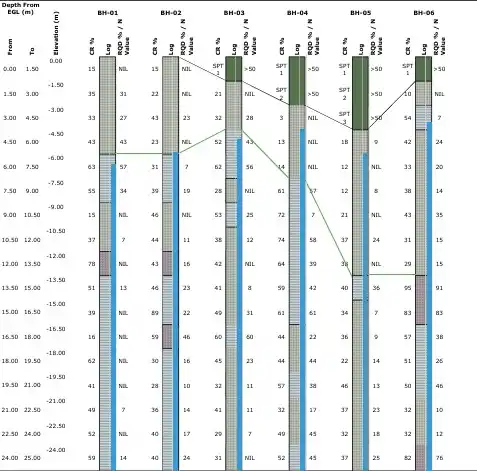
- Borehole Soil Sampling – Helps identify soil layers, groundwater level, and other critical characteristics.
Laboratory Tests
Laboratory analysis complements field investigations and provides detailed data on soil behavior:
- Grain size distribution
- Atterberg limits to determine plasticity
- Triaxial and direct shear tests for soil strength
- Moisture content and dry density tests
Typical Soil Bearing Capacity Values
The safe bearing capacity varies widely depending on soil type and local conditions. Indicative values are:
- Soft clay: 50–100 kN/m²
- Medium sand: 150–250 kN/m²
- Dense sand/gravel: 300–600 kN/m²
- Rock: greater than 1000 kN/m²
These values are a general guideline. Each construction site should have its SBC confirmed through proper investigation.
Factors Influencing Soil Bearing Capacity
Several natural and man-made factors affect how much load soil can safely carry. These include soil composition, moisture content, compaction, presence of organic material, foundation depth, and loading duration. Engineers must account for these variables when designing foundations.
Improving Soil Bearing Capacity
When the natural soil cannot meet design requirements, engineers apply various ground improvement techniques to increase SBC:
- Compaction to increase density and reduce settlement
- Soil stabilization using lime or cement for weak soils
- Installation of geotextiles or geogrids to reinforce soil
- Stone columns to improve load distribution in soft soils
- Use of pile foundations to transfer loads to deeper, stronger soil layers
In summary, understanding and accurately determining soil bearing capacity is a cornerstone of safe and efficient construction. Every step from field testing to laboratory analysis plays a vital role in ensuring that the structures built on top of the soil are stable, durable, and cost-effective for the long term.