Published by GeoSpectra Geotechnical Pvt. Ltd.
500 Ton Pile Load Testing at Panjim, Goa – CPWD High-Rise Building Project
High-Capacity Pile Load Testing Using the Kentledge Method with High-Precision Instrumentation
GeoSpectra Geotechnical Pvt. Ltd. successfully executed a high-capacity pile load testing project with a test load capacity of 500 tons for a high-rise building project at Panjim (Panaji), Goa, under the Central Public Works Department (CPWD).
The project involved evaluating pile performance under high loading conditions to assess load-carrying behaviour, settlement response and the performance of the pile foundation system. The test was conducted using the Kentledge Method, supported by high-precision measuring and monitoring instruments.
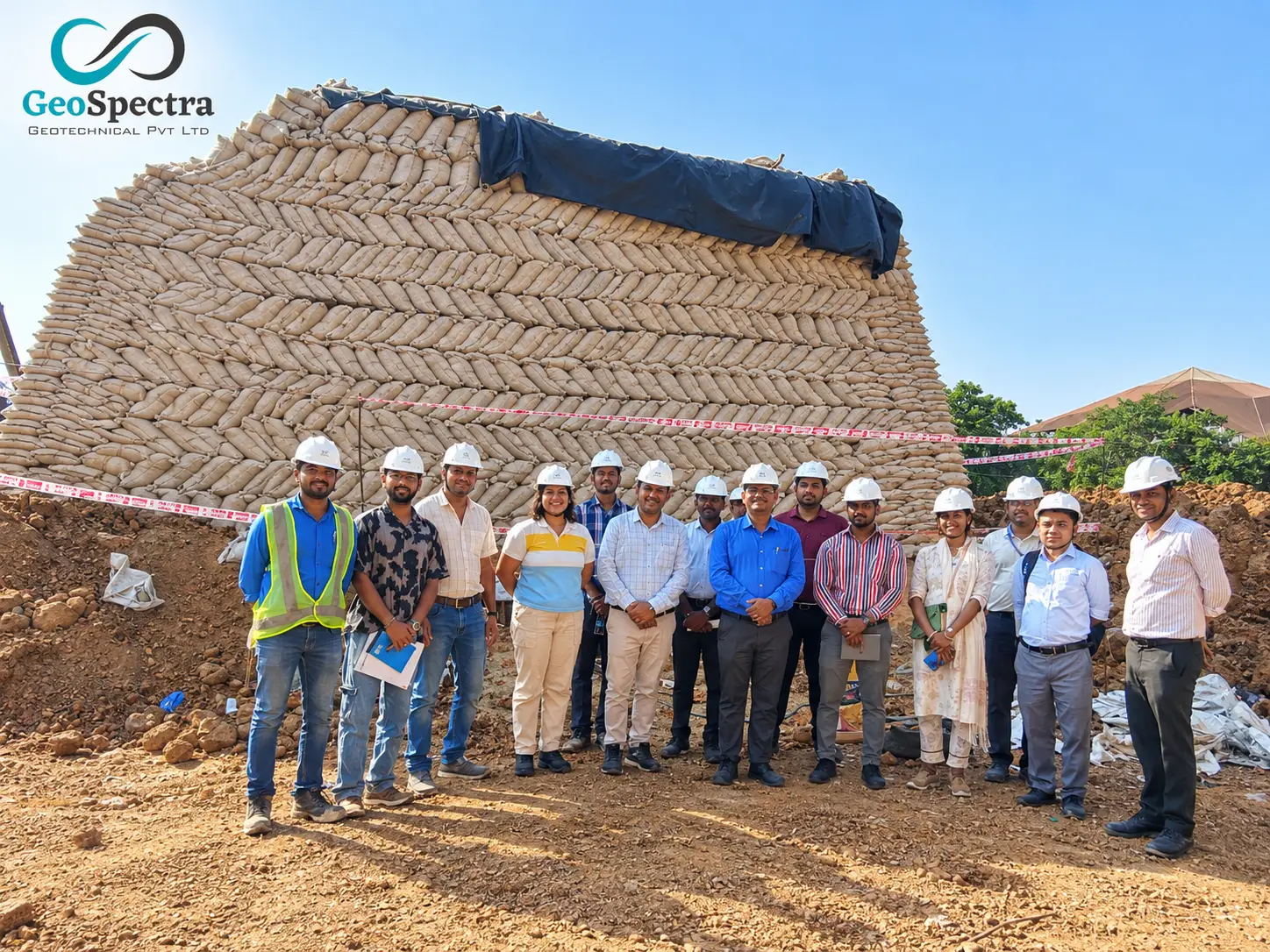
Project Overview
The project involved high-capacity pile load testing for a CPWD high-rise building in Panjim, Goa. The key project details and testing approach are summarized below.
| Company | GeoSpectra Geotechnical Pvt. Ltd. |
|---|---|
| Project Location | Panjim (Panaji), Goa, India |
| Client/Agency | CPWD – Central Public Works Department |
| Project Type | High-Rise Building |
| Test Load Capacity | 500 Tons |
| Testing Method | Kentledge Method |
| Service | High-Capacity Pile Load Testing |
| Measurement | High-Precision Instrumentation |
| Execution | GeoSpectra Geotechnical Pvt. Ltd. |
| Project Status | Successfully completed |
500 Ton Pile Load Testing
Pile load testing is an important part of foundation quality control, particularly for high-rise buildings and other heavily loaded structures. It provides information about the behaviour of piles under controlled loading conditions and helps engineers assess the load-settlement response of a foundation.
For this project at Panjim, Goa, the pile was subjected to a maximum test load of 500 tons. A suitable Kentledge arrangement was established to provide the required reaction against the test pile. The load was applied in a controlled sequence, while the corresponding pile movement and settlement were monitored at each loading stage.
The recorded measurements support the assessment of pile behaviour throughout the test. The interpretation of load-carrying capacity and settlement performance is based on the measured response and the applicable project specifications and acceptance criteria.
Kentledge Method for High-Capacity Pile Testing
The Kentledge Method is used to provide the reaction required during pile load testing. It involves a suitably arranged platform and counterweights that resist the load applied to the test pile.
For the 500-ton pile load test at Panjim, Goa, a suitable Kentledge platform and reaction arrangement were used to support the testing operation. The arrangement was intended to accommodate the required test load while maintaining stability and alignment during loading.
The Kentledge system enabled the high test load to be applied without relying on reaction piles. Proper planning of the reaction arrangement, loading equipment and site setup is important for the controlled and safe execution of high-capacity pile load testing.
High-Precision Measurement and Settlement Monitoring
Accurate measurement of pile movement is essential during static pile load testing. High-precision instrumentation helps record the settlement or displacement corresponding to the applied load and supports the preparation of a load-settlement response.
During this project, high-precision measuring and monitoring instruments were used to observe pile displacement and settlement under the applied load. The measurement setup was positioned and checked to help minimize external disturbances and support reliable readings.
Key Parameters Monitored During Pile Load Testing
- Applied load: The load applied to the test pile during each stage of the test.
- Pile settlement: The vertical movement recorded under the applied load.
- Load-settlement response: The relationship between the applied load and the measured pile movement.
- Unloading and rebound: The pile's observed response as the applied load is reduced.
- Test records: Measurements and observations used for technical analysis and reporting.
Pile Load Testing Procedure
A high-capacity pile load test requires systematic preparation, a suitable reaction arrangement, controlled loading and reliable measurements. The testing process for this project included the following activities:
- Preparation and verification of the test pile.
- Installation of the Kentledge reaction arrangement.
- Setup of the hydraulic loading system.
- Installation and checking of precision displacement-measuring instruments.
- Application of load in controlled increments.
- Recording of pile settlement at the relevant load stages.
- Maintenance of the specified loading conditions.
- Monitoring of unloading and rebound behaviour.
- Recording and analysis of the load-settlement response.
- Preparation of the pile load test report.
The loading sequence, measurement records and observations form the basis of the technical assessment. The interpretation of the test results should follow the applicable test procedure, project specifications and relevant acceptance criteria.
Importance of Pile Load Testing for High-Rise Buildings
Pile load testing provides field observations that help engineers assess foundation behaviour under an applied load. For high-rise structures, these observations are considered alongside foundation design, ground investigation findings and the relevant project specifications.
Pile load testing can help engineers evaluate:
- Pile load-carrying behaviour under the applied test load.
- Settlement observed at the recorded loading stages.
- The relationship between applied load and pile movement.
- Pile response during unloading and rebound.
- Foundation performance in relation to project requirements.
- Technical records required for engineering review.
For the Panjim project, the 500-ton test formed part of the foundation quality-control and performance-assessment activities for the high-rise building. The final engineering conclusions depend on the test measurements and the applicable project criteria.
GeoSpectra's Expertise in High-Capacity Pile Testing
High-capacity pile testing requires careful planning, a suitable reaction arrangement, appropriate measuring equipment, experienced technical personnel, systematic data collection and technical reporting. We successfully executed the 500-ton pile load testing project for a CPWD high-rise building project at Panjim, Goa.
We provide pile testing and geotechnical testing services for residential, commercial, industrial, infrastructure, bridge and high-rise building projects. Our testing approach is selected according to the foundation system, site conditions and project requirements.
Our services include:
- Static pile load testing.
- Compression pile load testing.
- Pile integrity testing.
- Dynamic pile testing.
- Geotechnical investigations and soil testing.
Learn more about our pile load testing services or explore our geotechnical investigation projects.
Looking for Reliable Pile Load Testing Services?
GeoSpectra Geotechnical Pvt. Ltd. offers pile load testing and geotechnical testing services for construction and infrastructure projects. Contact our team to discuss your site conditions, testing requirements and project specifications for projects in Goa and across India.
GeoSpectra Geotechnical Pvt. Ltd.
Building a Strong Foundation!
Phone: 9405069538
Email: info@geospectra.in
Website: www.geospectra.in
Serving Clients Across India | Geotechnical Investigation & Testing | Pile Testing | NABL Accredited Laboratory